National • as of 10 March 2026
2,021 hospitals
Reported as de-empanelled under AB-PMJAY.

Knowledge centre · Scheme integrity
Use data to identify unusual patterns, prioritise investigation and protect legitimate beneficiaries. A risk score is a reason to review—not proof of fraud.
Research checked: 12 October 2026 · Official observations and proposed applications are labelled separately.
AB-PMJAY provides a documented example of AI-assisted scheme oversight. A March 2026 parliamentary reply describes automated triggers for unusual claims and coordination between national and state anti-fraud units. Investigation and administrative action remain separate from an algorithmic alert. Read the parliamentary reply ↗
National • as of 10 March 2026
Reported as de-empanelled under AB-PMJAY.
National • as of 10 March 2026
Reported penalties levied for fraudulent activities; levied does not mean recovered.
These are national administrative totals, not the number or value of cases discovered solely by AI. Do not combine them with the historical state chart below.
A May 2026 NHA showcase presented approaches to analysing clinical documents, detecting conditions from radiology and identifying forgery or deepfakes. A showcase demonstrates development activity, not universal operational deployment or independently measured accuracy. Read the official showcase release ↗
Proposed workflow • adapt to each scheme and its authorised review process.
Validate records, dates and identifiers; document gaps.
Combine transparent rules with anomaly or network analysis.
Show reason codes and evidence to authorised reviewers.
Record the human finding and permitted action.
Use verified outcomes to monitor errors and model drift.
Start with simple controls. Missing records, duplicate payments and impossible dates may be better caught by a deterministic rule than a complex model. Add machine learning only when it improves a defined review task and can be assessed against reliable outcomes.
Proposed use cases—not claims that every scheme operates these models.
Entity matching can flag repeated identities or unusual payment relationships.
Review safeguard: Shared contact details or accounts can have legitimate explanations; verify eligibility and records.
Network analysis can highlight repeated vendor relationships or unusual pricing patterns.
Review safeguard: Compare like-for-like specifications and local conditions; a price outlier alone is insufficient.
Pattern checks can identify unusually repetitive attendance or payment records.
Review safeguard: Verify actual participation and data-capture failures before adverse action.
OCR and document analysis can surface inconsistent fields or possible reuse.
Review safeguard: Check the original record and issuer; a generative model must not invent supporting evidence.
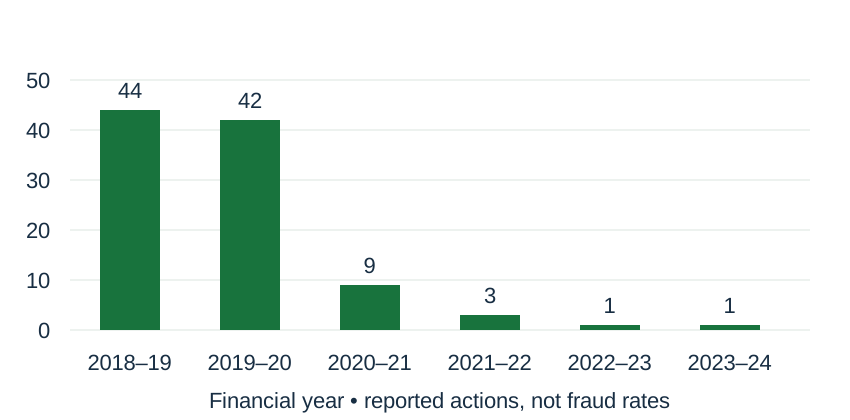
AB-PMJAY hospitals de-empanelled due to irregularities: five states listed in Annexure II of Lok Sabha Question 833, answered 7 February 2025. The chart sums reported entries for FY 2018–19 through FY 2023–24; the source is dated 1 February 2025.
On a narrow screen, scroll the chart horizontally to see all labels.
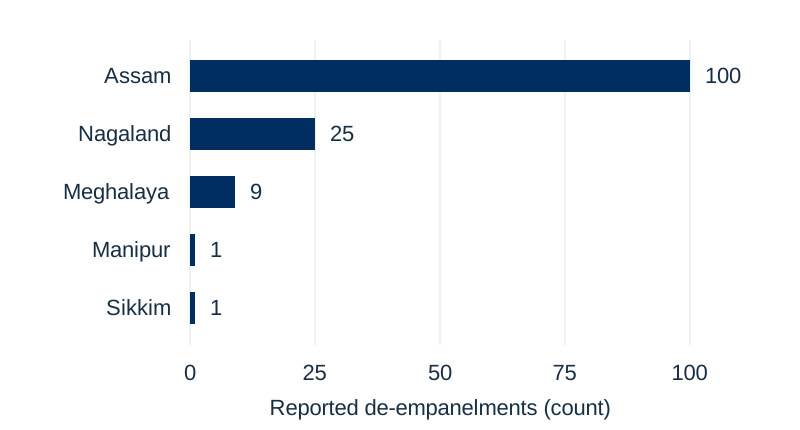
| State | Reported entries summed |
|---|---|
| Assam | 100 |
| Nagaland | 25 |
| Meghalaya | 9 |
| Manipur | 1 |
| Sikkim | 1 |
Only states listed in this annexure are shown. Omitted states and blank cells are not interpreted as zero. These actions are not attributed specifically to AI; no denominator is provided for a fraud-rate comparison.
Official state table: Annexure II, page 4 ↗ · Download chart data (CSV) ↓
On a narrow screen, scroll the chart horizontally to see all labels.
Of reviewed alerts, what share is substantiated? A large queue with many incorrect flags can consume capacity and harm users.
Review a defensible sample of unflagged records. Recall cannot be claimed when actual cases outside the alert queue are unknown.
Track review time, corrected errors, appeals and actual recovery separately from amounts suspected or penalties levied.
Compare errors across relevant regions and beneficiary groups where permitted. Reassess when scheme rules or data collection change.
Begin with a narrow pilot, a rules-only baseline and a documented evidence standard. Use verified investigation outcomes for training labels; historical allegations are not reliable ground truth. Test on a later period and check for leakage from information that would not have been available at the time of the decision.
Limit collection to authorised needs, restrict access, secure transfers and maintain a retention schedule. Reviewers should see the reasons for an alert and the source evidence. Keep a decision trail, a correction route and the ability to pause or roll back the model. Automated flags should not become automatic denial of benefits.
Run the model in shadow mode first: reviewers assess proposed alerts without allowing the system to change payments or eligibility. Agree success criteria and reviewer capacity before any operational use.
Download planning checklist ↓Explore digital governance advisory → · Prepare an advisory brief →